











































Santo Domingo, National District, Dominican Republic.- Theater has a unique quality: it transports us through sarcasm, dilettante wit, irony, documentary references, hard-to-digest truths, and situations few are willing to acknowledge as part of their own lives. Such is the case with depression, a modern epidemic that, to some extent, affects us all at some point in our lives.
HThere's little heroism in acknowledging one's own shortcomings. Some people I know refused to attend this unique one-woman show at Casa de Teatro, presented by Teatro Alternativo, directed by Lorena Oliva, the mentor who has guided so many new names in our theater scene, and starring Paloma Palacios.
We came to witness The depressed person We knew practically nothing about it. Even the program, in QR code format—as is the current trend—was found on a seat as we left the presentation. Only the promise implied by the title caught our attention. Not a synopsis, not a word to encourage us to attend.
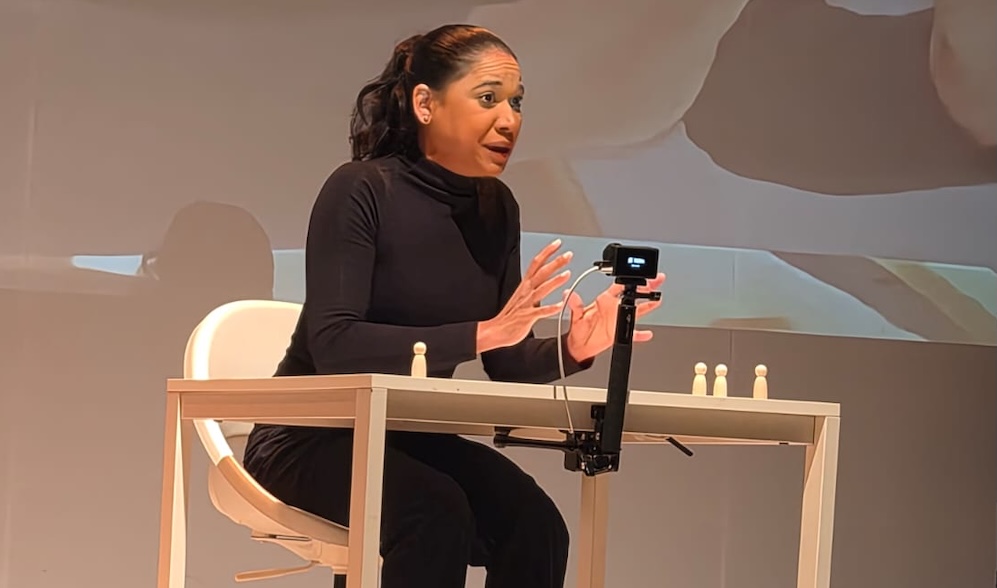
The story is based on the tale The Depressed Person, by the American writer David Foster Wallace (1962-2008), originally published in 1998 and included in his book Brief Interviews with Hideous Men. The staging presents us with an open stage, on a platform painted white. A large screen occupies the entire backdrop; a table and chair, also impeccably white, complete the space, suggesting an approaching therapeutic allusion. A distinctly clinical white. On the table, a camera with its black stand. To the right, a drummer with his instrument. Nothing more.
The set design is characterized by its operational simplicity: it dispenses with all artifice or impressionistic embellishment. There, on stage, is only what is necessary.
CWhen the performer enters the space, dressed in black —trousers and a blouse tight to the torso—, we find an actress willing to involve us in a complicit and close tone, supported by the immediate proximity between stage and audience.
She will appeal, as the original text states, to a circular discourse, repetitive in form, but heartbreaking and denouncing aspects that we rarely perceive when it comes to questioning the inhumanity and commercialization of therapeutic excesses in the treatment of depression.
It could have been an educational talk, but the intensity the actress brings to it draws the audience into a parallel reality, placing each person in the role of "the depressed person" and leading them to revisit their own or others' experiences. Throughout her speech, she weaves humor, irony, accumulated pain, denunciation, and absurdity.
LHis is an interpretive honesty that makes us aware that we are in the presence of a new stage brand. Palacios, coherent, convinced and convincing, Thanks to the skillful direction of the Argentine-Dominican teacher, it offers an acting performance worthy of having been seen by many more people than those gathered in those two performances only.
Technically, the montage is a testament to creative effectiveness. Without extensive resources, using only the essentials, the piece achieves visual depth thanks to precise technological management, which creates a sense of duplication in the image through a lip sync —the asynchrony between the movement of the lips and the words that are heard as if they were coming from them— projected, with a remarkable impact that redefines the sense of the stage space. That is one of his great achievements.
The introduction of Brandy Paulino, The Dominican drummer, music educator, and cultural manager, in his live performance, establishes a production technique that sets this work apart. He provides dramatic support through the music and establishes a rhythmic foundation for the unfolding events. This is complemented by the lighting design, which gives light a fundamental role.
The play, as we have been able to verify in international reports, had a successful run in Buenos Aires, performed by María Onetto and directed by Daniel Veronese, at the San Martín Cultural Center. In our country, it achieves a sense of closeness, involvement, and participatory emotion, due to the author's keenness in describing the pitfalls of the great trap that occurs when a patient is abused through exploitative therapy, lacking a genuine desire to help them. It also questions and demystifies certain "support groups.".
The figures of speech used by Foster Wallace and the way Palacios recites them, whether through subdued anguish or intense, emphatic pronouncements, gradually strip away the imagery of this therapeutic resource. But, avoiding the obvious, the work isn't even about depression. It's a questioning of the very essence of us all, ordinary people who, deep down, mask our selfishness and who, in reality, are only beholden to our own interests.
The work is about human loneliness, the kind that accompanies us all and that we don't always acknowledge. It takes the depression of a woman, X, and transforms it into a manifesto that denounces us all… and everyone. That is its value.
OI wish it could be revived, especially so that art critics and journalists who didn't see it could have the opportunity to see how much theater can do with just a good actress, a sensitive director, a great musician, and a technical support team that has been faithful to the art for years.
This is not a conventional work about an illness. The text also questions selfishness, self-pity, interpersonal relationships, emotional dependence, and the capacity of others to support those who suffer.
Synopsis
The depressed person It is a theatrical adaptation of a short story by the American writer David Foster Wallace. A universe of circular and intrusive thoughts unfolds on stage. Words that repeat themselves, are interrupted, and return, seeking to be shared, perhaps for the first time, perhaps for the last.
In front of witnesses he desperately needs, the depressed person tries to find in the act of being heard a way to continue existing.
About the author

David Foster Wallace (1962-2008) He was an American writer, essayist, and professor. He studied English and philosophy at Amherst College and creative writing at the University of Arizona. His works include the novel Infinite Jest (1996) and the book of essays Let's talk about lobsters. In 1997 she received a MacArthur Fellowship.
He published "The Depressed Person" in Harper's Magazine in 1998. The story received an O. Henry Award and was included in Brief interviews with repulsive men (1999). In the story, the sentences lengthen and the footnotes open new digressions. Thus, we hear the effort of a woman who measures each word when she asks for help, attentive to how she is being heard.
Technical specifications
Author: David Foster Wallace
Playwriting and direction: Lorena Oliva
Performance: Paloma Palacios
Live music: Brandy Paulino
Assistant Director: Anny Road Lachapel
Lighting design: Julio Núñez
Audiovisual: Joaquín Venegas
Production: Alternative Theatre
